

Scripture quotations taken from the Holy Bible, New International Version® NIV®. Copyright © 1973, 1978, 1984, 2011 by Biblica, Inc.® Used by permission. All rights reserved worldwide.
Watch the service
Reflection
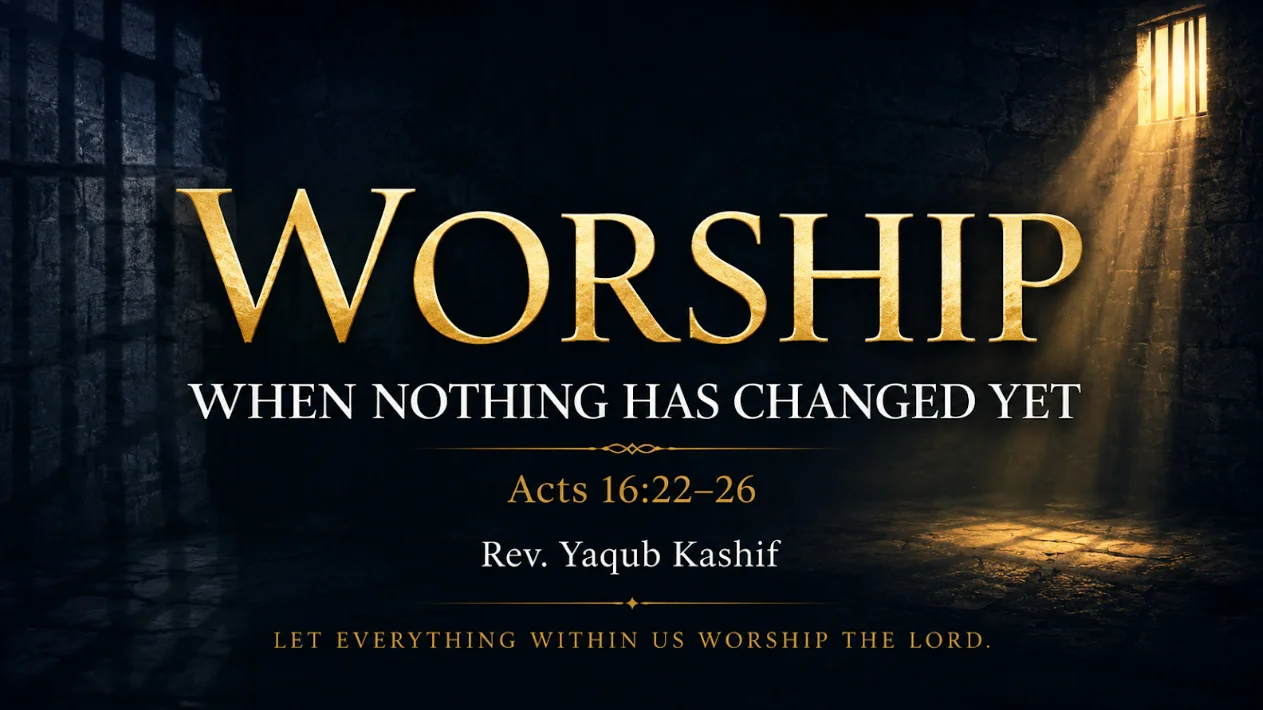
Worship When Nothing Has Changed Yet
(Acts 16:22-26)
Rev. Yaqub Kashif
Acts 16 takes us into one of the New Testament’s most powerful scenes of worship. Paul and Silas were in Philippi preaching the gospel of Jesus Christ when opposition suddenly rose against them. The crowd attacked them, the magistrates ordered them to be stripped and beaten with rods, and after receiving many blows they were thrown into prison. The jailer was commanded to guard them carefully, so he placed them in the inner prison and fastened their feet in stocks. Before there was an earthquake, before any door opened, and before any chain came loose, there was humiliation, pain, restriction, and a long night in which nothing appeared to be changing. Their suffering reminds us that obedience to God does not mean that believers will never experience hardship. Paul and Silas were not suffering because they had abandoned the mission of Jesus Christ; they suffered while faithfully carrying the gospel forward. Their clothes were stripped from them, but their calling could not be stripped away. Their bodies were wounded, but their identity in Christ remained secure. In the same way, life can sometimes remove things we once depended upon positions, relationships, opportunities, reputation, or security but what happens around us cannot remove who we are in Jesus Christ. The text also says their feet were fastened in stocks. Literally, the stocks restricted their movement and prevented escape, but the picture also speaks powerfully to seasons when progress seems to stop. Feet carry us forward; they are associated with movement, journey, mission, and advancement. Paul had been moving from place to place with the gospel, yet suddenly the feet that had carried Christ’s message were restrained. It looked as though his progress had been stopped, but restrained movement did not mean canceled purpose. Paul’s feet were restrained, but the gospel was not restrained. His personal movement was limited, but Jesus Christ’s mission continued to advance. Then Acts 16:25 brings us to the heart of the story: “About midnight Paul and Silas were praying and singing hymns to God, and the other prisoners were listening to them.” Midnight was first of all a real hour in a real prison, but it also gives us a powerful picture of certain seasons in our lives. Midnight is dark, but midnight is also a time of transition. Yesterday has ended, a new day has technically begun, yet morning is still not visible. Something has changed in time before the eyes can see the evidence. There are seasons when life feels exactly like that. Something behind us has ended, yet the next chapter is still unclear. We cannot return to yesterday, but we cannot yet see tomorrow. The door remains closed, the wound still hurts, and progress still feels restrained. Acts 16 teaches us not to make permanent conclusions in temporary nights. At midnight, morning is not visible, but the new day has already begun. Paul and Silas could not see the earthquake that was coming, the doors that would open, the jailer who would later ask about salvation, or the household that would soon rejoice in God. All they could see was midnight, and yet they worshiped. Their worship was not a technique for making God send an earthquake. They did not sing in order to manipulate God or force Him to change their circumstances. They worshiped because God was worthy even before anything changed. They prayed because prayer expresses dependence upon God, and they sang hymns “to God” because God Himself not the miracle, not the open door, and not the breakthrough was the object of their worship. Mature worship does not say, “God, give me what I want, and then I will praise You.” Mature worship says, “God, because You are who You are, I will worship You even while I wait.” Later in the chapter, the jailer washes their wounds, which means those wounds were still untreated while Paul and Silas prayed and sang. The wound had not been washed, but worship had already begun. Nobody had apologized, the prison had not changed, and the stocks had not yet opened, but worship had begun. This is the kind of worship that declares that God is worthy not only after the testimony but also in the waiting. It is the worship of Habakkuk, who could look at circumstances that appeared to be failing and still say, “Yet I will rejoice in the LORD.” Perhaps the first miracle of Acts 16 does not occur when the earthquake comes in verse 26. Something remarkable is already happening in verse 25: the prison has their bodies, but not their worship. Before their feet become free, their hearts are free. Before God changes what is around them, the Holy Spirit sustains something within them that refuses to become imprisoned by bitterness, fear, or despair. Sometimes we ask God to change our circumstances first, but God also desires to bring freedom within us. An open door means little if bitterness, unforgiveness, and fear simply walk through it with us. Luke also tells us that “the other prisoners were listening to them.” Paul and Silas were worshiping God, but their worship had an audience. Their prison unexpectedly became a place of witness. Those prisoners understood pain, darkness, chains, and hopelessness, but that night they heard something different: wounded men worshiping God. Their suffering had placed them in a setting where people who might never have entered a church could hear what faith sounded like in the middle of pain. In the same way, sometimes the greatest sermon a believer preaches is not spoken from a pulpit but seen in the way he or she continues to trust Jesus Christ through suffering. Then God sovereignly intervened. A violent earthquake shook the foundations of the prison, the doors opened, and the prisoners’ bonds came loose. Yet the story does not end with an open door. The jailer, believing that the prisoners had escaped, was about to take his own life when Paul cried out, “Do not harm yourself! We are all here!” Paul was not only physically free; he was free from revenge. The man who had suffered was now concerned about the life of the man connected with his imprisonment. This is also the power of the Holy Spirit not only power to celebrate, but power to forgive, love, and respond like Jesus Christ. The jailer then came trembling before Paul and Silas and asked, “Sirs, what must I do to be saved?” The worshipers had become witnesses, and the hearer himself asked for the way of salvation. Paul did not tell him to believe in the earthquake, the miracle, or their worship. He answered, “Believe in the Lord Jesus, and you will be saved.” Paul and Silas then spoke the Word of the Lord to him and to his household. The center of the story is not an earthquake in Philippi; the center is Jesus Christ. The gospel immediately began producing visible fruit. The jailer took Paul and Silas and washed their wounds. The man who had confined them now cared for the prisoners’ wounds. He and his household were baptized; he brought Paul and Silas into his home, gave them food, and rejoiced because he had come to believe in God. The story begins with a crowd attacking but ends with a household rejoicing. It begins with wounds being inflicted but ends with wounds being washed. It begins with feet being restrained but ends with the gospel moving into another household. This is the message of Worship Sunday: worship can survive the wound, true worship does not wait for circumstances to change, and true worship becomes a witness to others. Perhaps some of us are still standing in verse 25. The prayer has been prayed, the wound still hurts, progress feels restrained, and the door has not opened. Yet the central question remains: Is Jesus Christ still worthy when nothing has changed yet? The answer of Acts 16 is yes. Jesus Christ is worthy before the answer, during the waiting, and after the breakthrough. Our greatest reason for worship is not that every circumstance will immediately change, but that Jesus Christ has died for our sins, God raised Him from the dead, and He is Lord. Therefore, whether the door is open or still closed, whether morning is visible or we are still standing at midnight, our confession remains the same: Christ is risen. Christ is Lord. Christ is worthy.
The praise came before the earthquake — and that order is the whole point.
Sermon materials
Join us every Sunday at Ilsan English Worship. Everyone is welcome.


