

Scripture quotations taken from the Holy Bible, New International Version® NIV®. Copyright © 1973, 1978, 1984, 2011 by Biblica, Inc.® Used by permission. All rights reserved worldwide.
Watch the service
Reflection
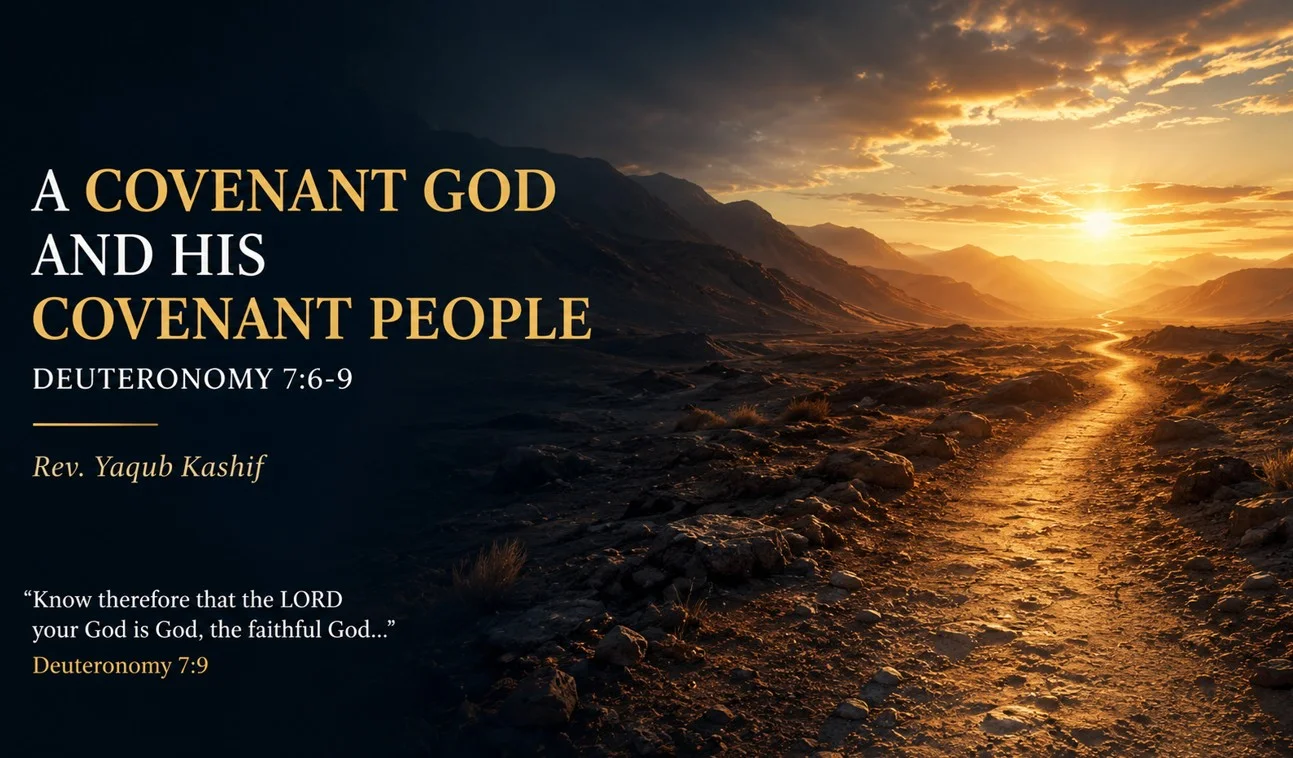
A COVENANT GOD AND HIS COVENANT PEOPLE
Deuteronomy 7:6–9
Rev. Yaqub Kashif
Sermon Summary
Deuteronomy 7:6–9 brings us to a decisive moment in Israel’s history. Behind them were Egypt, the Passover, the Red Sea, and the wilderness. Before them stood the Promised Land and an uncertain future. Moses himself was preparing to die, and a new generation was preparing to move forward. Much was changing, but Moses directed Israel’s attention to the One who had not changed: “the faithful God who keeps covenant and steadfast love… to a thousand generations” (Deuteronomy 7:9).
This gives us the central truth of the passage: Our security as God’s people does not rest in our greatness, but in the grace, redeeming love, and covenant faithfulness of God. Generations changed. God did not.
A key biblical word in this passage is בְּרִית (berit) – covenant. God’s covenant is a solemn relationship established by God in which He commits Himself according to His promise and calls a people to belong faithfully to Him. Throughout Scripture, its heartbeat is expressed in the promise: “I will be their God, and they shall be my people” (Jeremiah 31:33).
Chosen and Treasured – Deuteronomy 7:6
Moses first reminds Israel of their covenant identity: they are holy, chosen, and treasured. “Holy” means they have been set apart for God. They are “chosen” because God has taken the initiative, and they are His “treasured possession” because they belong particularly to Him.
This order is important: before God tells them what to do, He reminds them whose they are. Our deepest identity is not finally determined by our profession, achievements, possessions, failures, or the opinions of others. Scripture takes us deeper than the question, “Who am I?” and asks, “Whose am I?”
This covenant language reaches forward into the New Testament. In 1 Peter 2:9, God’s people are described as “a chosen race, a royal priesthood, a holy nation, a people for his own possession.”
Not Because of Greatness, but Because of Grace – Deuteronomy 7:7
Why did God choose Israel? Moses immediately removes every reason for human boasting: “It was not because you were more in number… for you were the fewest of all peoples.”
The Hebrew verb בָּחַר (bāḥar) means “to choose.” God’s choice was not His recognition of Israel’s greatness; it was an expression of His grace. Deuteronomy 9:4–6 reinforces this truth by warning Israel not to believe that God’s blessing came because of their own righteousness.
This truth speaks both to pride and insecurity. Pride says, “God must accept me because I am something.” Insecurity says, “God could never receive me because I am nothing.” Grace confronts both.
Grace destroys pride, but grace also heals insecurity.
Covenant Love Acts – Deuteronomy 7:8
Verse 8 reveals the movement of God’s covenant love: He loves, He keeps His oath, He brings His people out, and He redeems. Israel could look backward to Egypt, Passover, the Red Sea, and freedom and see that God’s love had acted within history.
God’s love has history attached to it.
The Exodus, however, also points beyond itself. Egypt was real bondage, but humanity faces a deeper bondage-the slavery of sin and death. The New Testament therefore declares, “Christ, our Passover lamb, has been sacrificed” (1 Corinthians 5:7). The Exodus displays God’s redeeming action in history; Christ brings God’s saving purpose to its climactic fulfillment.
When circumstances make God’s love difficult to understand, Christians look ultimately to the cross. The greatest evidence of God’s love is not that every circumstance follows our plans, but that God has acted decisively for our redemption in Jesus Christ.
The Faithful God – Deuteronomy 7:9
The theological climax comes in verse 9:
“Know therefore that the LORD your God is God, the faithful God who keeps covenant and steadfast love… to a thousand generations.”
The Hebrew expression is הָאֵל הַנֶּאֱמָן (ha’el hane’eman) – “the faithful God.” Faithfulness is not merely something God occasionally does; faithfulness belongs to who God is.
Two further words deepen the message: בְּרִית (berit) – covenant, and חֶסֶד (ḥesed) – steadfast love. God is not merely a covenant-making God. He is a covenant-keeping God.
This covenant story runs through Scripture: God promises to Abraham, remembers and redeems Israel from Egypt, forms His people at Sinai, calls them to faithfulness in Deuteronomy, promises a new covenant in Jeremiah 31, and brings that redemptive purpose to fulfillment in Jesus Christ. At the Last Supper Jesus declares, “This cup… is the new covenant in my blood” (Luke 22:20).
Human unfaithfulness did not end God’s redemptive purpose; it revealed our need for the faithful Redeemer.
Remember, Love, Obey
God’s grace calls for a response. Deuteronomy summarizes covenant life in three powerful actions:
Remember – “You shall remember the whole way that the LORD your God has led you” (Deuteronomy 8:2).
Love – “You shall love the LORD your God with all your heart…” (Deuteronomy 6:5).
Obey – God’s people are called to love Him and keep His commandments (Deuteronomy 7:9).
We do not obey in order to persuade God to make us His people. We obey because by grace we belong to Him. Grace is the root; obedience is the fruit.
Deuteronomy 7:6–9 therefore leaves us with both identity and responsibility: chosen by grace, redeemed by love, sustained by God’s faithfulness, and called to covenant faithfulness.
Our circumstances may change. Generations will change. Leaders will change. Nations will change. We may not know everything our future contains, but Moses does not tell Israel, “Know your future.” He tells them, “Know… your God.”
Remember who you are-but even more importantly, remember who He is.
GENERATIONS CHANGED. GOD DID NOT.
הָאֵל הַנֶּאֱמָן – ha’el hane’eman – THE FAITHFUL GOD.
God’s love for His people is not a reward for their greatness — it is a revelation of His own faithful character.
Sermon materials
Join us every Sunday at Ilsan English Worship. Everyone is welcome.


